 ← Adam R. Cobb
Targeting the vmPFC with near-infrared light
A model-based dosimetry and feasibility framework for reaching a deep, ventral brain target transcranially — with transcranial infrared laser stimulation and methylene blue.
The ventromedial prefrontal cortex (vmPFC) is central to fear extinction and emotion regulation, and a mechanistically appealing target for PTSD. But it sits ~40–45 mm deep and ventral — and whether transcranially delivered near-infrared light actually reaches it, in adequate and thermally safe dose, has never been quantified across real head anatomy. This project builds an open, reproducible pipeline to answer that, and to establish a citable dosimetry standard.
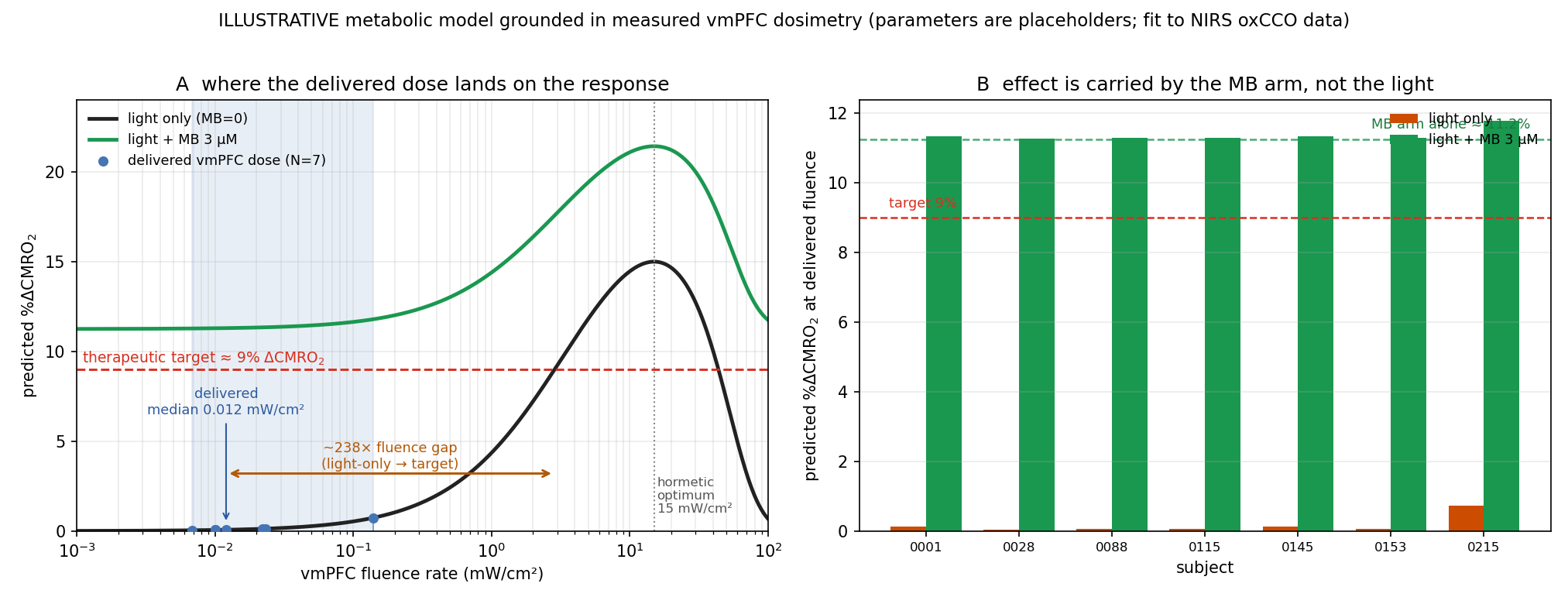
Across seven head models at 1064 nm from an Fpz montage (Monte-Carlo photon transport + a bioheat safety model), a bare surface beam lands orders of magnitude below a stimulation threshold at depth. The question then becomes: which physical levers can close that gap?
Interactive explorer
Each of the seven subjects' measured vmPFC dose is mapped onto an illustrative metabolic dose-response. Adjust methylene blue, beam aperture, optical clearing, scalp cooling, and incident power — and watch where the delivered dose lands relative to a target effect.
Methods paper in preparation. Pipeline and figures are openly released for reproducibility.